Two Teslas, one Powerwall, one 80A connection: How Gavin made single-phase power work
⚡ The Setup in Numbers
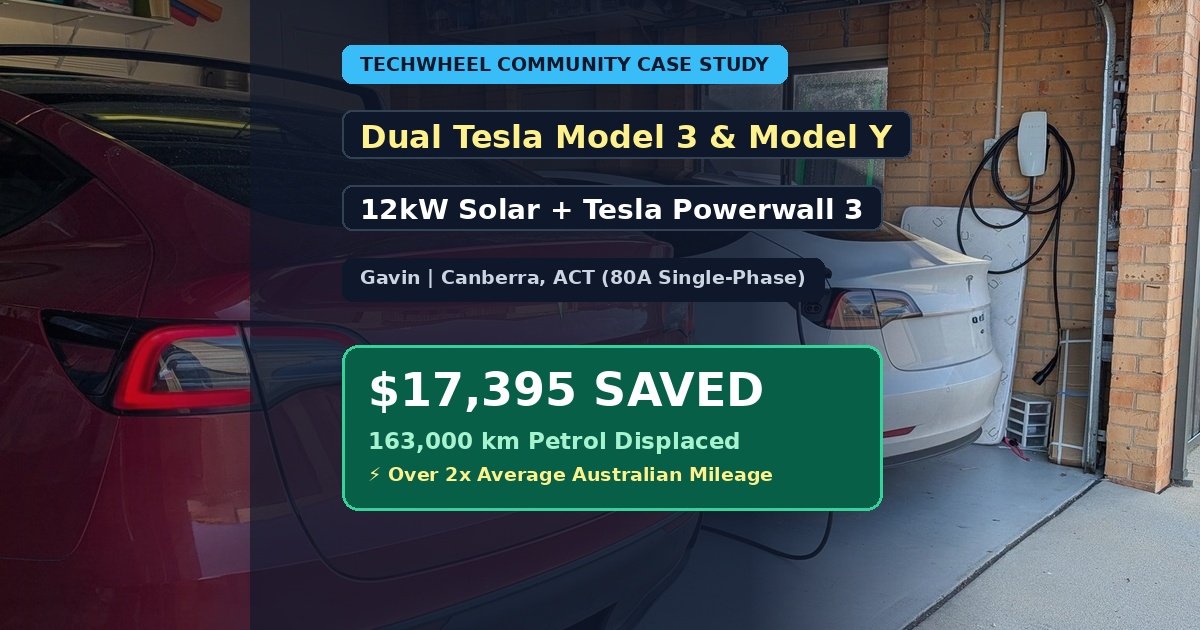
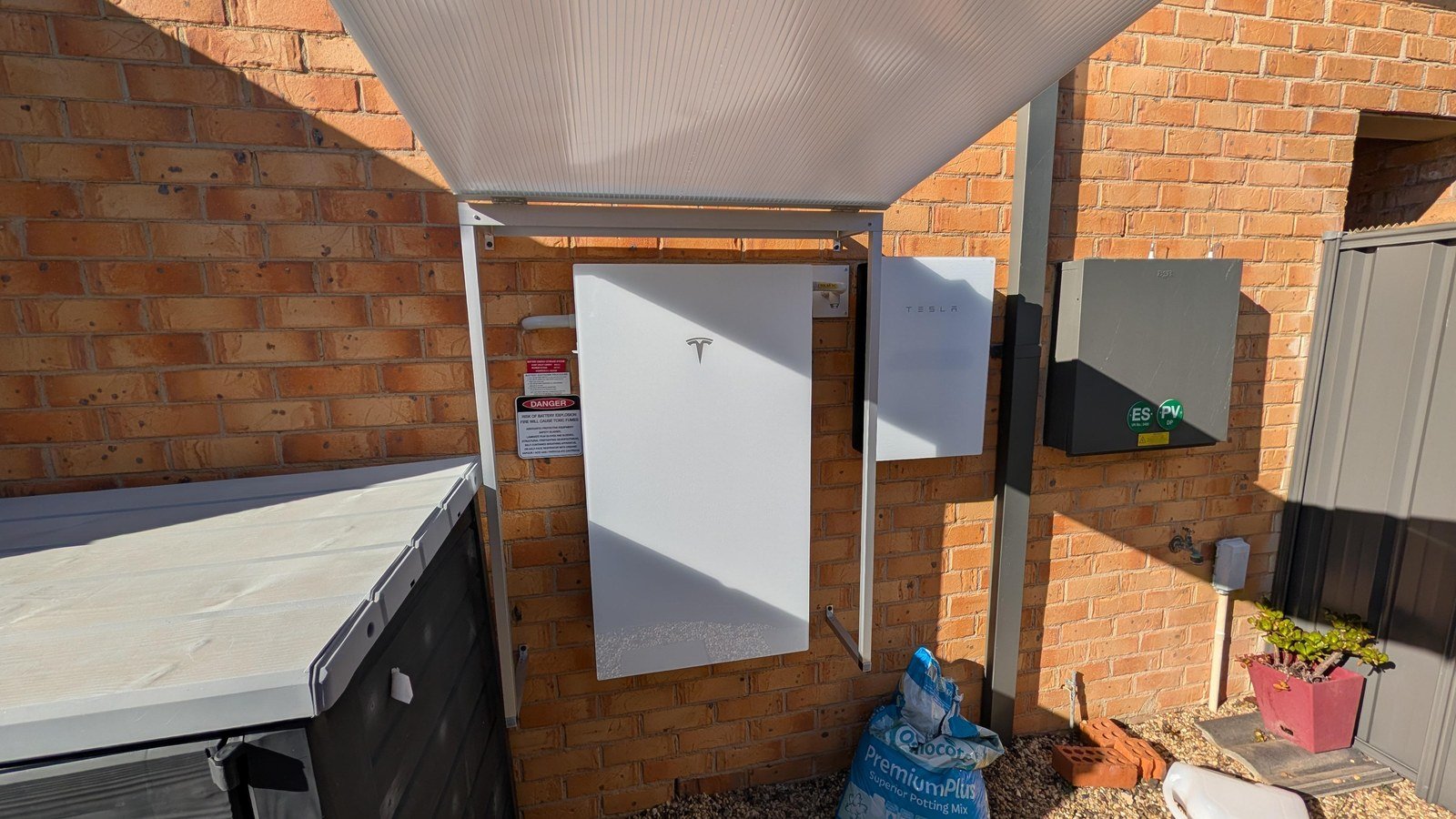
- Hardware: 12 kW rooftop solar + 13.5 kWh Tesla Powerwall 3 + Dual Tesla Wall Connectors
- Fleet: 2023 Tesla Model Y (“Hot Dog”) + Tesla Model 3 (“Brum”)
- Tracked distance: 163,235 km driven across both vehicles (~50,000 km/year household pace)
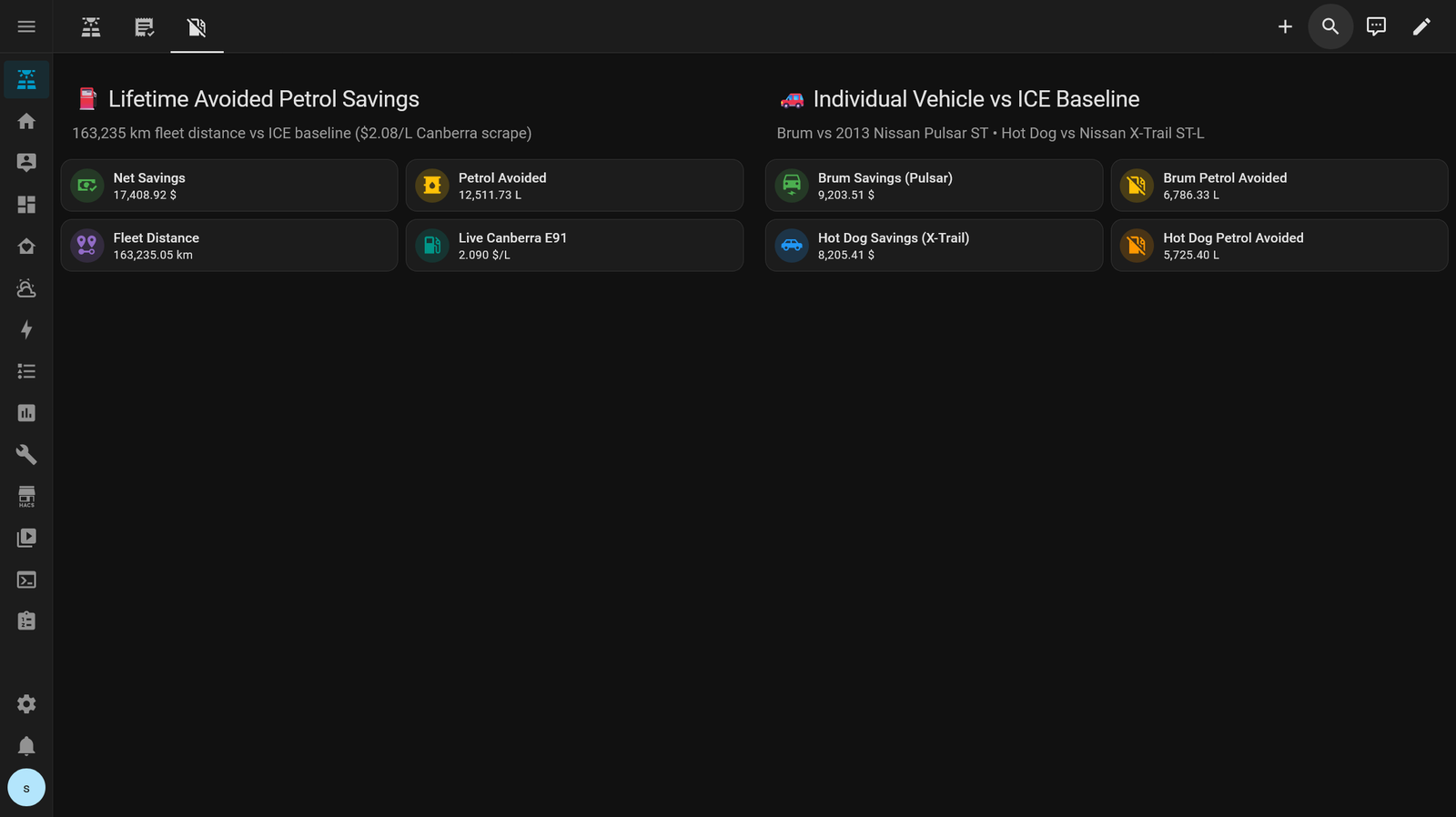
- Petrol displaced: 12,511 Litres of ULP 91 avoided
- Avoided fuel costs: $17,395 saved on fuel ($6,393 electricity vs $23,788 petrol equivalent)
- Winter wholesale audit: 42% energy cost reduction on Amber spot pricing vs Origin flat-rate
- Control system: Raspberry Pi 4 running Home Assistant + Tessie API + Amber API + Solcast
Ask most electricians what happens when you try to charge two electric vehicles at 32 amps each, run ducted reverse-cycle air conditioning through a freezing Canberra winter, and charge a 13.5 kWh battery on a standard 80-amp single-phase connection.
They will tell you you are dreaming. Or they will tell you to spend $10,000 upgrading to three-phase power.
For Canberra homeowner Gavin, spending five figures on a network upgrade was out of the question. But so was paying $2.20 a litre for petrol or exporting solar power to the grid for a meager 3 cents per kilowatt-hour.
Instead, Gavin spent a few weekends at his workbench with a $200 Raspberry Pi 4. Pairing live vehicle telemetry via the Tessie API, 48-interval wholesale forecasts from Amber Electric, and solar predictions from Solcast, he built an automated energy orchestration system in Home Assistant.
The result? Over 163,000 kilometres logged across two Teslas, 12,500 litres of petrol displaced, and $17,395 in avoided fuel expenses. Here is how the system works, the software logic protecting his 80A main breaker, and the practical lessons other Australian households can adapt.
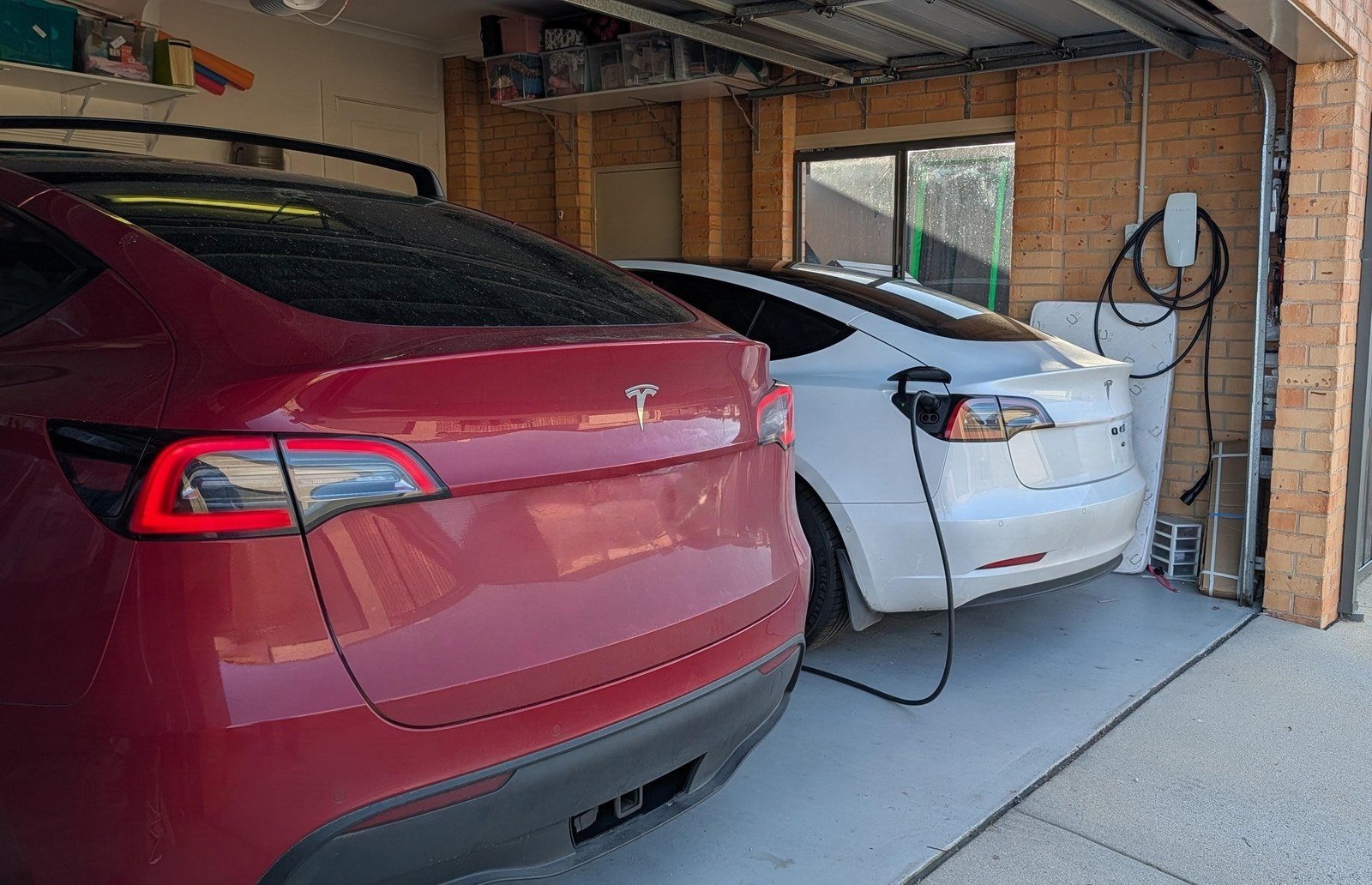
The 80A single-phase dilemma
Most Australian suburban homes sit on a 63A or 80A single-phase supply.
When you install a single 32A EV wall charger, it draws 7.4 kW—taking nearly half your total electrical budget. Install two 32A chargers, and you face a theoretical 64A draw before anyone turns on an induction cooktop, boils a kettle, or runs reverse-cycle heating on a sub-zero Canberra night.
Without intelligent load management, you face two unattractive choices: spend thousands on a three-phase supply upgrade and switchboard rewire, or derate both chargers to a sluggish 16A (3.6 kW), severely limiting your ability to soak up midday solar peaks.
Gavin took a practical third route: software-managed load shedding.
By measuring household demand at the meter level every 30 seconds inside Home Assistant, the system monitors total house draw. If the kitchen and ducted heating spike, Home Assistant dials back the Tesla Wall Connectors from 32A down to 16A or 6A per vehicle. When domestic appliances switch off, charging current ramps back up.
The main service breaker operates comfortably within its 80A threshold, and both cars charge at maximum speed whenever spare capacity exists.
Why Amber’s native app was not enough
Amber Electric is known among energy enthusiasts for passing through wholesale spot prices. When utility solar floods the National Electricity Market, prices regularly plunge below zero, occasionally paying consumers to absorb grid energy.
Amber provides native smart EV charging features in its mobile app. However, that feature is built around single-vehicle households.
In a two-EV home, single-car logic runs into clear limitations:
– It cannot compare state-of-charge between two cars to prioritise the emptier battery.
– It cannot coordinate charging current across chargers to stay within a single-phase service limit.
– It does not automatically coordinate with home storage to prevent the Powerwall from discharging expensive stored energy into the cars during cheap grid windows.
Rather than relying solely on the retail app, Gavin built custom multi-device orchestration in Home Assistant using Amber’s open 48-interval forecast API to coordinate both cars and the Powerwall in lockstep.
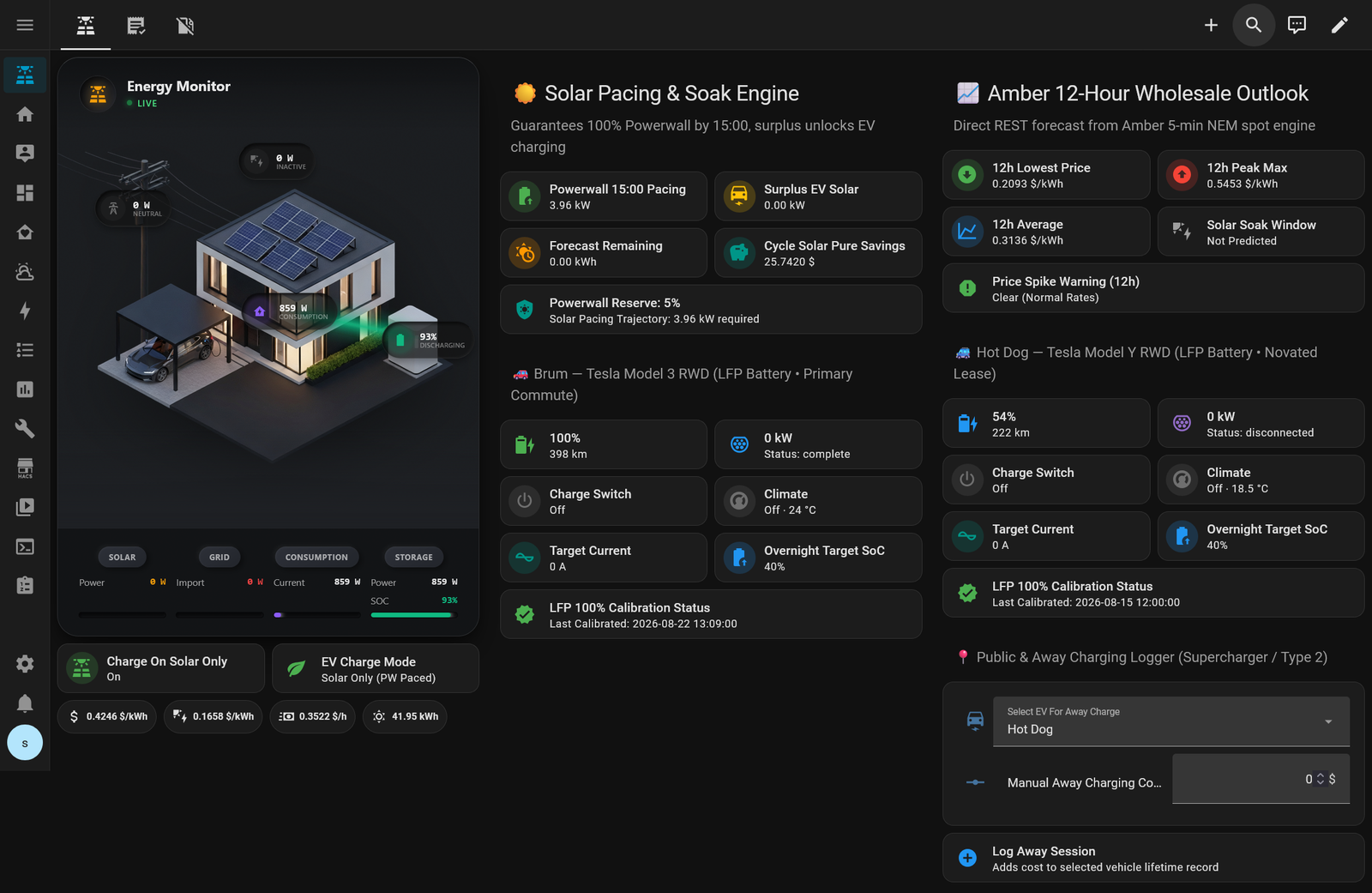
The 5-step automation engine: Solcast, ratchets and breaker guards
Inside Home Assistant, charging current follows five defined operating rules:
Tier 1: The automated rising Powerwall ratchet
When cheap wholesale grid prices trigger vehicle charging, Home Assistant locks the Powerwall reserve limit to match its current state of charge.
As rooftop solar generates power throughout the day, the software ratchets the reserve upward alongside the battery’s rising charge level. Rooftop generation continues to fill the home battery, but the Powerwall cannot dump stored energy into the cars. At 5:00 PM, the reserve limit resets to 5%, allowing the battery to power household loads during the evening peak.
Tier 2: Predictive 3:00 PM solar pacing
Letting the home battery charge at maximum speed early in the morning leaves no solar headroom for the cars.
Using daily solar forecasts from Solcast, the system computes the minimum continuous charge rate required to reach 100% capacity by 3:00 PM. Solar generation above this calculated pacing curve is directed into the vehicle chargers between 6A and 32A, capturing daytime driving range on self-generated power.
Tier 3: Dual-EV prioritization and cell balancing
When both cars are plugged in, Home Assistant allocates charging capacity to the vehicle with the lowest battery percentage up to maximum speed, offering remaining headroom to the second car.
Because Lithium Iron Phosphate (LFP) packs require regular 100% charging cycles to calibrate their battery management systems, the automation tracks days since each car last reached a full charge. If seven days elapse without a 100% top-up, that car’s priority is elevated during upcoming solar windows.
Tier 4: Hardware contactor anti-chatter protection
Wholesale spot prices update every five minutes, and rooftop solar output shifts rapidly as cloud cover moves across Canberra.
To protect the physical switching relays in the Tesla Wall Connectors, Home Assistant applies a 30-second settling filter before switching chargers on or off. This prevents rapid contactor flapping and reduces mechanical wear on switching hardware.
Tier 5: Overnight bottom-line safety net
Each vehicle has a configurable minimum battery target (such as 50%). If a vehicle sits below that threshold before bedtime, Home Assistant schedules an overnight charge between midnight and 6:00 AM, activating only when Amber’s price descriptor reports very low or negative spot rates.
The fuel displacement math: 163,000 km and $17,395 in avoided petrol
To evaluate actual fuel savings, Gavin imported historical charging data from Tessie into Home Assistant and matched every charging session against prevailing regional ULP 91 petrol prices ($1.65 to $2.25/L) for the routes and dates driven.
This $17,395 figure reflects avoided fuel expenses (hypothetical petrol costs minus actual electricity costs). It does not include capital costs, tyres, maintenance, or registration.
Here is the operational breakdown across both vehicles:
1. Tesla Model 3 (“Brum”)
The Model 3 replaced a 2013 Nissan Pulsar ST manual consuming an average of 7.2 L/100km. Over 94,255 km of tracked driving, the Tesla displaced 6,786 Litres of petrol. Total electricity costs came to $3,640 compared to $12,838 for equivalent fuel, delivering $9,199 in avoided fuel costs.
2. 2023 Tesla Model Y (“Hot Dog”)
The Model Y replaced a 2015 Nissan X-Trail ST-L petrol SUV averaging 8.3 L/100km. Across 68,981 km, it avoided 5,725 Litres of fuel. Charging costs totaled $2,754 against $10,951 at the bowser, yielding $8,196 in fuel savings.
The combined fleet reality
Across 163,235 km, the two electric vehicles consumed $6,394 in electricity across home solar soaking, off-peak grid imports, and public fast chargers. Fueling the previous petrol vehicles for the same distance would have cost $23,789 across 12,511 Litres of ULP 91.
The difference is $17,395 in direct fuel expense savings.
While this comparison excludes tyre wear, vehicle purchase prices, and depreciation, it demonstrates the cash-flow impact of shifting high-mileage commuting from liquid fuels to residential electricity.
The high-mileage factor: 50,000 km per year across two cars
Understanding how fuel savings accumulated this quickly requires examining the household’s total driving volume.
According to the Australian Bureau of Statistics (ABS) Survey of Motor Vehicle Use, an average Australian passenger vehicle travels approximately 12,100 kilometres annually. For a two-car suburban household, typical driving volume totals roughly 24,200 kilometres each year.
Gavin’s household operates at more than double that benchmark:
– Model 3 (“Brum”): 94,255 km across ~3.8 years (~24,800 km/year)
– Model Y (“Hot Dog”): 68,981 km across ~2.7 years (~25,500 km/year)
– Total Household Driving Pace: ~50,000 km annually across both vehicles
Driving volume dramatically changes the financial payback of home charging and rooftop solar. A low-mileage household clocking 8,000 km annually uses modest amounts of fuel, making infrastructure payback relatively slow.
At 50,000 km per year, however, the household would consume roughly 4,000 to 5,000 litres of petrol annually. At typical Canberra fuel prices of $1.90 to $2.20 per litre, that equates to $7,500 to $9,500 in yearly fuel expenditure.
For Gavin’s previous petrol vehicles, which consumed roughly 8 L/100 km on average (7.2 L/100km in the Pulsar and 8.3 L/100km in the X-Trail), every 100 km of driving represented about $16.00 in fuel at $2.00/L. Because his Teslas consume approximately 15 kWh to cover that same distance, every kilowatt-hour of self-consumed solar displaces roughly $1.07 in retail petrol expenses. Against an export feed-in tariff of just 3¢/kWh, self-consuming that solar in an EV yields a financial return far superior to exporting power back to the grid.
The winter wholesale audit: Amber vs Origin flat-rate
Canberra summers provide ample energy: Gavin’s 12 kW array produces 60 to 80 kWh daily, providing sufficient generation to run household heating, the battery, and vehicles with minimal grid assistance.
Winter presents the actual financial test. With half the panels oriented south, generation drops to 25–30 kWh daily, requiring substantial grid imports to support daily driving.
Gavin compared actual expenses on Amber wholesale spot pricing against Origin Energy’s standard flat rate (34.7¢/kWh + $1.45/day supply) across a four-month winter billing period (May to August, 3,431.86 kWh imported):
- Actual Amber wholesale energy cost: $691.40 (averaging 20.15¢/kWh)
- Total Amber invoice (including daily supply charge and monthly membership): $885.56
- Equivalent Origin Energy flat-rate bill: $1,353.79
- Measured out-of-pocket winter difference: $468.23 (a 42% reduction in pure energy charges)
Automated charging during off-peak and negative wholesale pricing periods contributed $255 of that four-month saving.
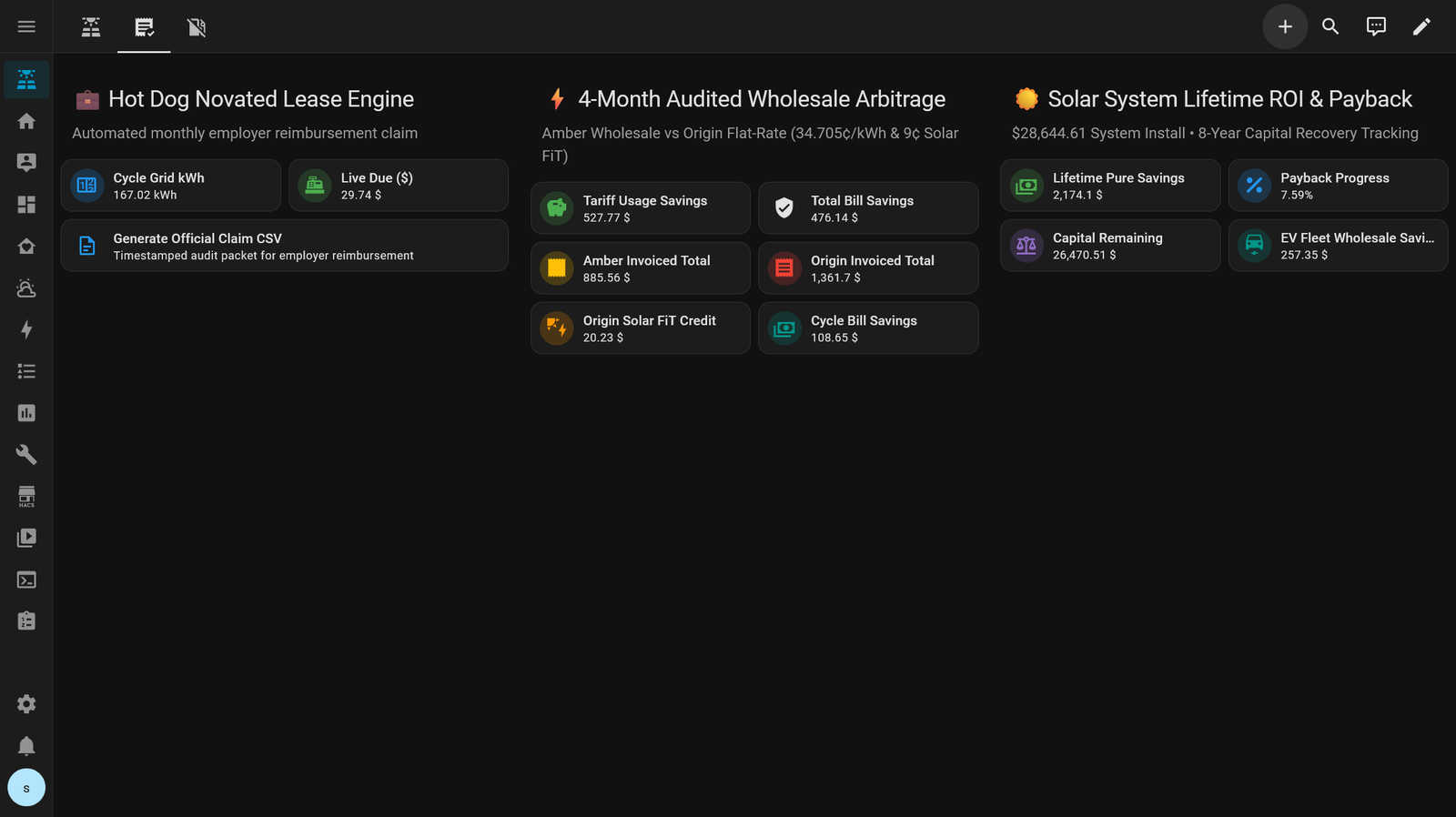
Telemetry sub-metering for novated lease reporting
Gavin’s Model Y is financed through an employer novated lease utilizing the federal Electric Car Discount.
Under standard employer novated lease reimbursement processes, drivers typically need to substantiate actual electricity expenses incurred for vehicle charging, separating out-of-pocket grid costs from self-generated rooftop solar. Because electricity retailers provide a single consolidated monthly bill, isolating vehicle charging on a mixed-use residential connection can be challenging.
Gavin addressed this challenge with automated sub-metering in Home Assistant:
– The system logs power demand every 30 seconds during active charging sessions, recording grid import levels alongside solar production.
– Home Assistant tags charging volume supplied by the grid separately from rooftop generation.
– At the end of each billing cycle, the system compiles an itemized summary logging charging dates, durations, vehicle odometer figures, and calculated grid energy charges matching monthly wholesale rates.
This provides clear audit records for reimbursement without manual logging.
Open-source project: the Powerflow integration for Home Assistant
Rather than leaving this control logic in custom configuration files, Gavin is packaging the orchestration engine into a public Home Assistant Community Store (HACS) integration: https://github.com/nougartman/ha-powerflow.
While currently in early development, the integration connects with Amber Electric’s 48-interval forecast API, Tessie telemetry, and solar prediction tools to assist Australian households in deploying automated solar pacing, battery reserve protection, and contactor safety logic. Gavin plans to update the repository with all the features incorporated into this automation, so if you’re tech-savvy, feel free to bookmark it..
Key practical takeaways for home setups
Households do not need dual electric vehicles or custom programming to apply these practical lessons:
- Evaluate software load management before costly upgrades: If your home has an 80A or 63A single-phase connection, smart load balancing via Home Assistant or smart wall chargers may avoid the need for an expensive three-phase upgrade.
- Divert excess solar into transport before grid export: Exporting power at low 3–5¢ feed-in tariffs offers slow returns. Diverting that generation into an EV replaces liquid fuel and significantly increases the effective value of self-consumed solar.
- Protect home batteries from vehicle charging cycles: On time-of-use or wholesale pricing tariffs, configure your battery settings so stationary storage does not unintentionally discharge into vehicles during low-cost grid charging windows.
Got an EV, solar, or a home battery?
Share your real-world setup in the TechWheel Community Survey — it takes about five minutes and powers free, independent research for Australian households. We feature standout community setups in deep-dive case studies just like this one.
🔒 100% independent • No sales calls • Aliases and privacy fully respected
Frequently asked questions
Can you charge two EVs on a single-phase connection in Australia?
Yes. Automated load balancing throttles charging current in real time based on household demand, keeping aggregate draw safely within standard 63A or 80A main service breaker limits without requiring an expensive three-phase upgrade.
How much money does an EV save compared to petrol in Australia?
Based on 163,000+ km of tracked driving in this case study, charging via rooftop solar and off-peak wholesale electricity cost $6,393.87, compared to $23,788.92 for equivalent petrol (12,511 Litres of ULP 91)—delivering $17,395.05 in avoided fuel expenses. Total vehicle savings will vary depending on purchase prices, depreciation, insurance, and maintenance.
Can you claim home solar EV charging on a novated lease?
Under standard employer novated lease policies, drivers generally claim out-of-pocket electricity costs incurred from the grid. By utilising telemetry sub-metering in Home Assistant, homeowners can document charging volume supplied by the grid separately from rooftop solar for reimbursement claims.