How Two EVs and a 32 kWh Battery Slashed an Ipswich Home’s Power & Fuel Bills by $5,900/Year
Fed up with throwing money at the local bowser and watching household electricity bills top $380 a month, Goose took action. His fix was not to cut back on driving or trim home energy use. He went all-in on home generation and storage instead.
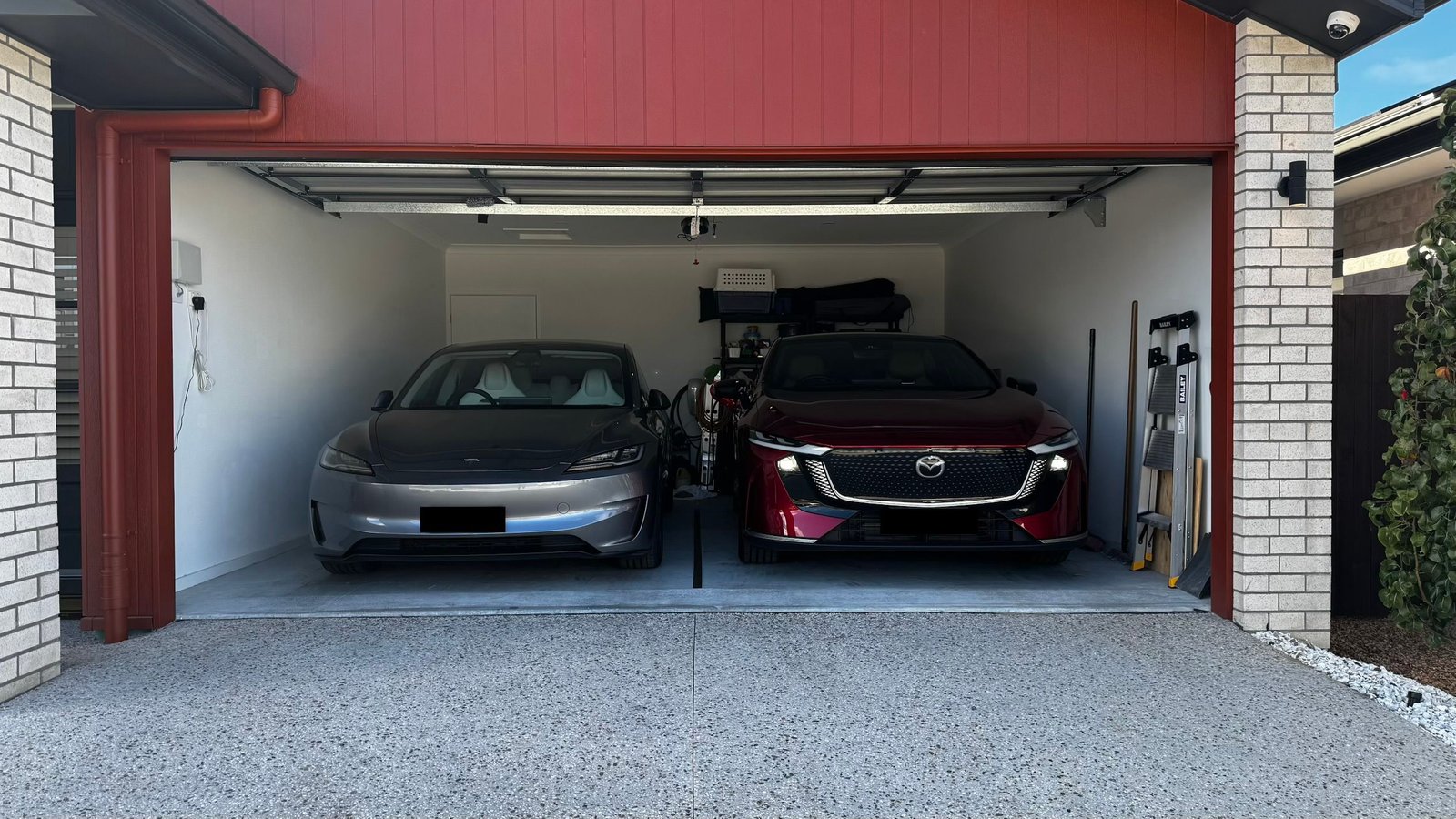
Parked under a tin roof in suburban Ipswich, Queensland, his garage now houses a Tesla Model 3 and a Mazda 6e. Both run on energy generated right above them. Paired with an 11+ kW solar array and a massive 32 kWh Sigenergy battery, this household wiped out its fuel costs and dropped net power bills under $150 a quarter.
The payoff? Quarterly electricity bills less than $150, a self-consumption rate of ~50%, and an estimated $5,940 in combined annual savings. Here’s how the system works, what it cost, and what it signals for other Australian households weighing the switch.
⚡ The story in numbers
- System: 11+ kW solar + Sigenergy battery (32 kWh) + Tesla Model 3 + Mazda 6e
- Annual savings: $5,940 (EV $1,975 + solar/battery $3,965)
- Battery payback: 5.2 years on $20,500 invested (electricity savings + EV charging offset)
- Strategy: Dynamic pricing optimisation: Automatically charge/discharge based on off-peak/free grid power.
The setup: solar, battery and EVs
Goose lives in a standalone home on a single-phase grid connection. Single-phase wires come with strict export limits. Any extra solar power generated during midday hours either gets stored locally or disappears into the grid for peanuts.
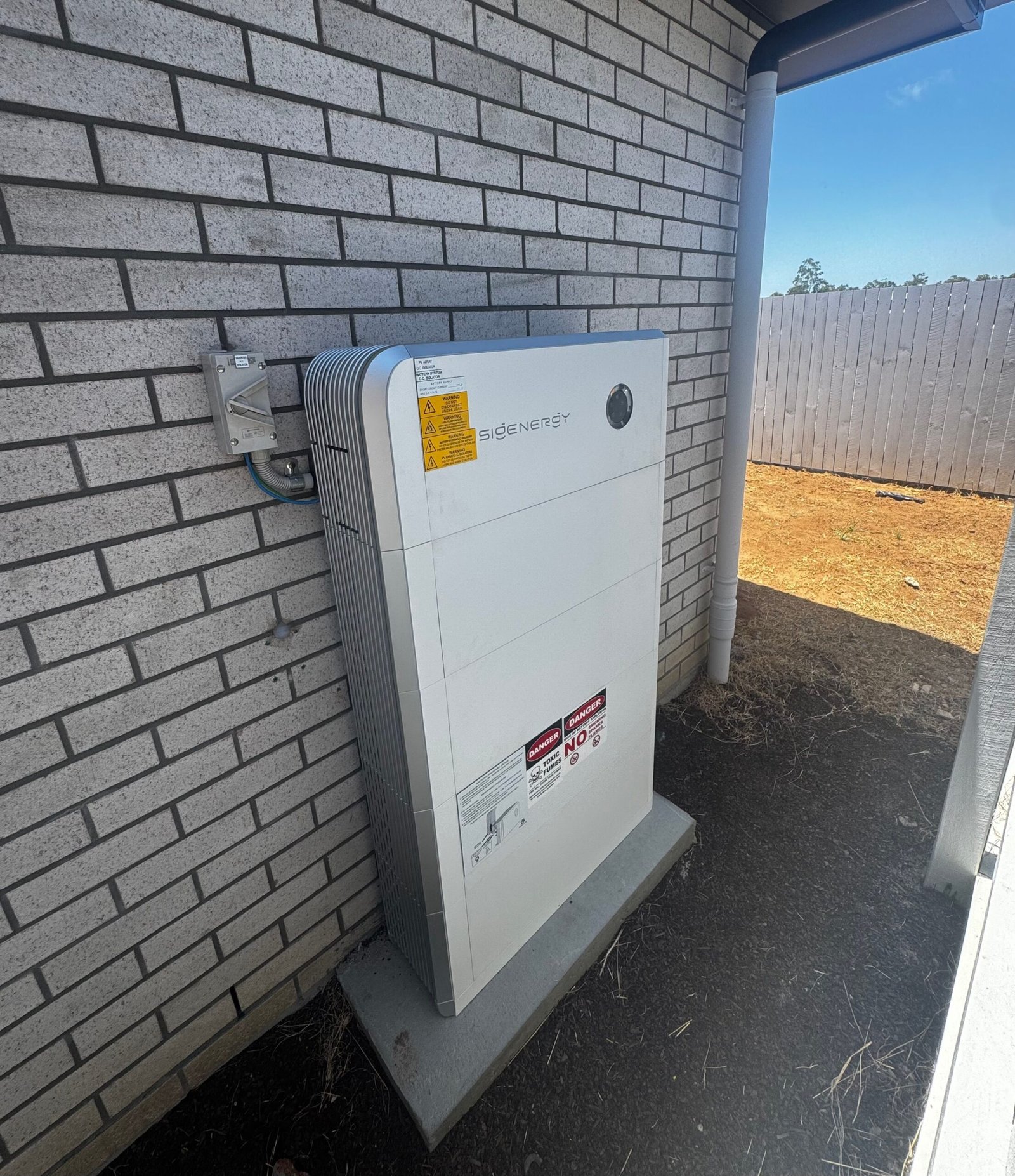
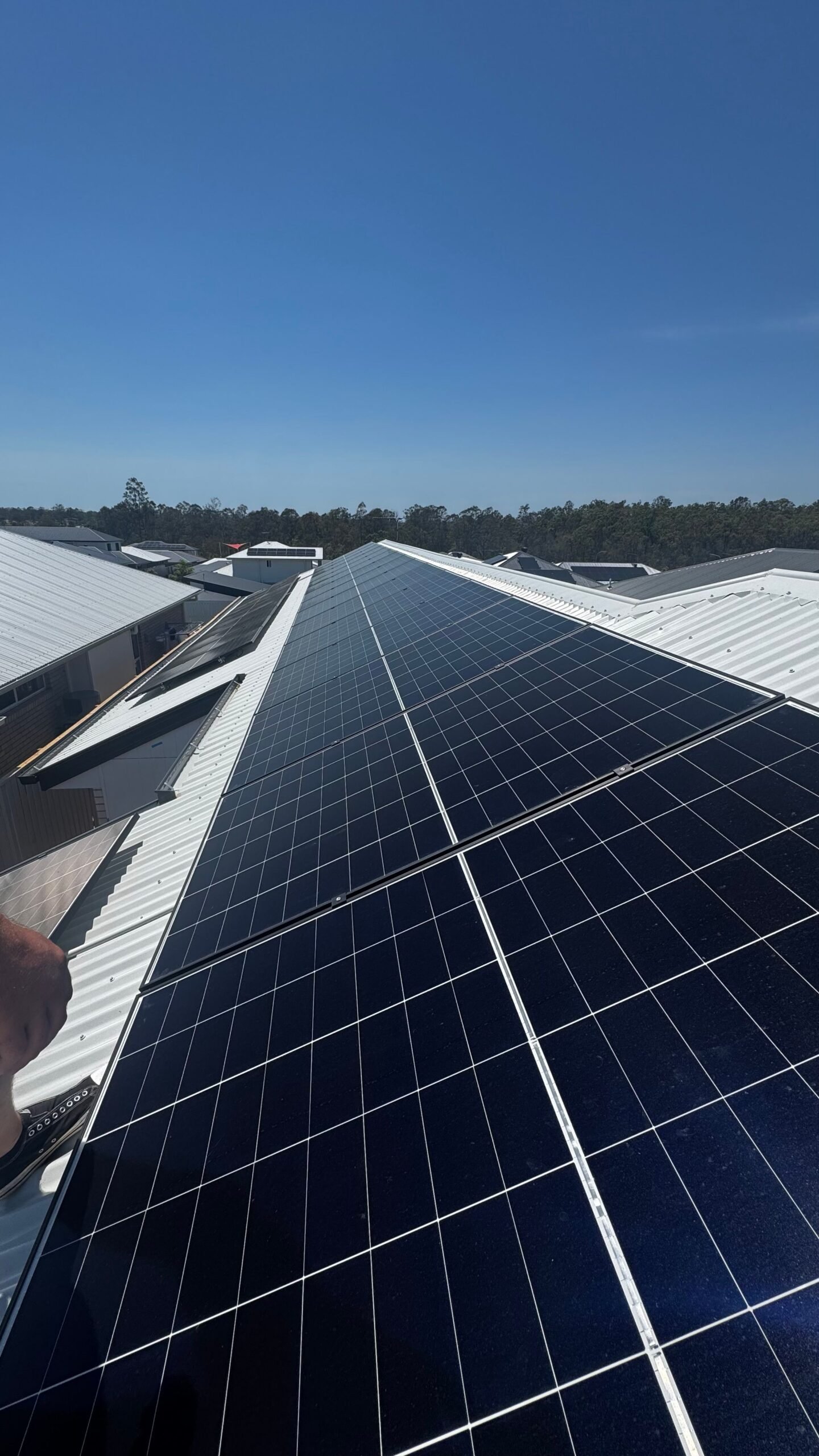
To tackle that bottleneck, he installed an 11+ kW solar array back in 2025 alongside a 32 kWh Sigenergy SigenStor modular battery stack. He pulled in the federal Cheaper Home Batteries rebate to soften the upfront hit, keeping hardware and installation costs to $20,500.
How the system runs day to day
Goose manages charging for both electric vehicles on his single-phase connection using a single 7 kW wall charger.
Instead of paying for an expensive three-phase upgrade, he uses the vehicles as flexible daytime energy sponges. The 7 kW charger runs directly off rooftop solar when generation peaks during midday hours. When solar output drops or driving demands increase, stored energy in the 32 kWh Sigenergy battery—or cheap overnight grid windows via his FlowPower spot-pricing tariff—tops up the fleet.
With two fully electric vehicles in the driveway, petrol is completely out of the picture. Public DC fast chargers are reserved strictly for long road trips outside southeast Queensland.
The numbers: what it costs and saves
Electricity saving: $3,600 per year
EV charging offset: 4,560 kWh × 8.0 c/kWh (off-peak EV plan) ≈ $365 per year (the battery powers the EV’s night-time charging)
System investment: $20,500
Battery payback: $20,500 ÷ $3,965 = 5.2 years (electricity savings + EV charging offset; petrol savings are not included)
To measure the battery’s value conservatively, Techwheel calculates the EV charging offset at 8.0 c/kWh—the standard off-peak rate Goose would otherwise pay to charge from the grid overnight without solar storage. By supplying that 4,560 kWh directly from his stored rooftop energy, the battery saves an additional ~$365 per year in avoided grid charging costs.
EV value case (separate):
Petrol avoided: $30–$60 per week × 52 weeks ≈ $2,340 per year
EV energy use: 30,000 km ÷ 100 × 15.2 kWh/100km ≈ 4,560 kWh per year
EV charging cost: 4,560 kWh × 8.0 c/kWh (off-peak EV plan) ≈ $365 per year (already counted in the battery offset above)
Net EV saving: $1,975 per year — this offsets the EV’s own purchase price, not the battery
Combined household benefit: $5,940 per year
EV efficiency varies by model (typically 12–20 kWh/100km); 15.2 kWh/100km is derived from this owner’s battery size and range. Off-peak EV plans (~6–8c/kWh) are the Australian norm for night-time charging.
While Goose estimates a total return in roughly four years across his whole clean-energy transition, Techwheel’s conservative methodology isolates the solar and battery hardware ($20,500). Accounting strictly for reduced power bills and avoided overnight charging—while separating out vehicle fuel savings—lands the standalone solar and battery payback at 5.2 years.
The owner’s perspective
Asked what would speed up clean energy adoption across Australia, Goose points straight at red tape, complex network approvals, and upfront cost barriers.
Our electricity bills went from ~$380 a month down to -$40 a month. In just 12 months we’ve saved over $5,000, which is a quarter of our entire solar and battery system. It will net a full return in four years.”
He turned down Virtual Power Plant (VPP) offers, preferring to keep full control of his stored energy rather than letting a third party cycle his battery.
Why this matters now
Goose’s setup lands at a critical turning point for Australian energy users. A few shifting market forces highlight why this matters right now:
📰 Why it matters now
- NSW confirms EV road-user charge — $440M over 3 years, from July 2027 (The Driven, 2 Aug 2026) — NSW Treasurer Daniel Mookhey confirmed at a parliamentary inquiry (Jul 31) the state will press ahead: EV drivers charged >3c/km, PHEVs 2.4c/km. NSW would prefer a national scheme (and says the Commonwealth could refer powers), but will legislate alone if needed. WA is also proposing a road-user charge for July 2027. Victoria’s 2021 scheme was struck down by the High Court in 2023.
- Tesla produces its 10 millionth EV — six years after its first million (The Driven, 2 Aug 2026) — milestone hit at Fremont; more than 180,000 Teslas have landed in Australia. Market-momentum story for EV confidence content.
- AEMO real-world data: batteries cut evening grid imports by 73% (AEMO, 2 Aug 2026) — QED Q2 2026 compared 10,000 solar+battery homes vs 10,000 solar-only: battery homes drew just 0.3 kW average from the grid 4–9pm vs ~1.0 kW (73% less). Same quarter: wholesale prices fell sharply, gas generation hit its lowest Q2 in 20+ years, and grid batteries increasingly set evening prices.
- How EV owners should actually use the new “3 free hours” Solar Sharer plans (SolarQuotes, 2 Aug 2026) — SolarQuotes detail piece: free window capped at 24 kWh/day; NSW/QLD run 11am–2pm, SA 12–3pm; a wall socket adds only ~30 km per window (~10 km/hr) vs ~120 km on a 7 kW Level 2 charger (~40 km/hr); warns on switchboard capacity (single-phase ~80% of east-coast homes; switchboard rebuilds from ~$1,000) and scheduling sync with retailer windows.
Techwheel analyst commentary
Goose’s setup is a textbook example of full-household electrification—two EVs, an 11+ kW array, and 32 kWh of battery storage working in tandem. With petrol completely out of the fleet, transport energy comes entirely from the roof.
Goose no longer sweats peak grid prices, global oil spikes, or volatile bowser costs. He opted out of the fossil fuel supply chain altogether.
Three takeaways:
(1) Dual EVs eliminate petrol dependency completely. No remaining exposure to fuel price volatility.
(2) Solar plus off-peak management keeps running costs minimal. High self-consumption preserves maximum value on-site.
(3) The battery pays for itself in roughly 5.2 years. Electricity savings and night charging offsets repay the hardware, while petrol savings pay off the vehicles separately.
This case study is built from a real submission to the Techwheel community survey. All figures come from the owner’s own responses (system specs, bills, odometer readings and spend), cross-checked by Techwheel editors. Savings estimates use Australian state fuel benchmarks and household electricity baselines; individual results vary. Submissions are published only with the owner’s approval.
Frequently asked questions
How much does Goose save with the EV and solar setup?
Combined, roughly $5,940 a year: $1,975 from vehicle fuel offsets (petrol saved minus charging energy) and $3,965 from solar and battery operations (bill reductions plus night charging offsets).
How does Goose use his 32 kWh battery to keep bills under $150 a quarter?
Instead of exporting solar to the grid for low feed-in tariffs, Goose routes excess daytime generation straight into his 32 kWh Sigenergy battery stack. That stored energy runs the house through the evening peak (4 PM–9 PM) and tops up the EVs during from sun and/or . Maximising on-site battery storage is what shields his household from expensive grid imports.
Is a home battery worth it in Australia?
For Goose, yes. With 32 kWh of storage, his system achieves a full payback in about 5.2 years on electricity savings and overnight charging offsets. Individual payback timelines vary depending on location, tariff structures, and household daily load profiles.
Got an EV, solar or a home battery?
Share your real-world setup in the Techwheel community survey — it takes about five minutes and powers free, independent research for Australian households.